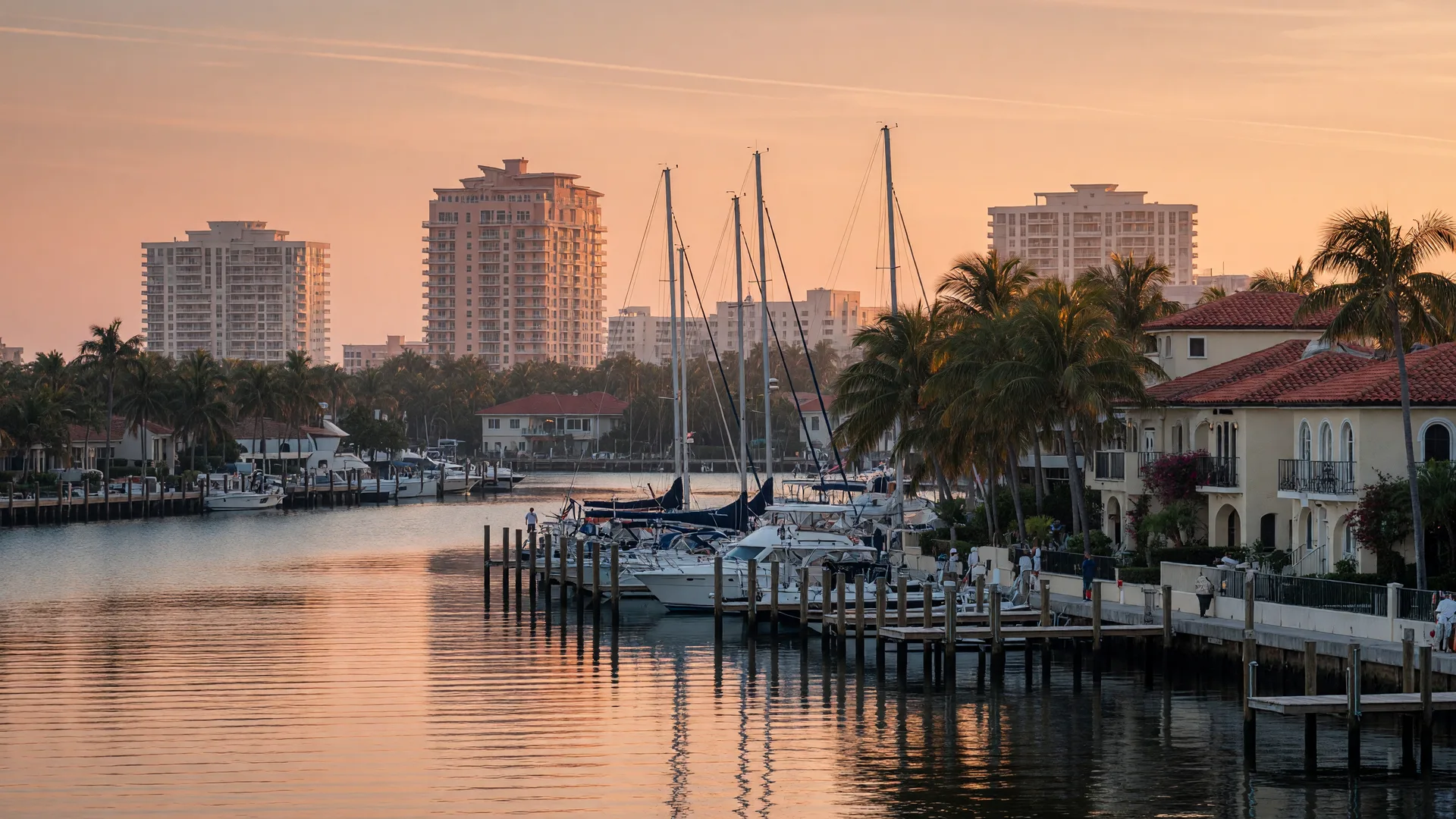
Broward County in late 2026 is a tale of two markets. Single-family homes are in a mild seller's market with a $650,000 median price, up 4.0% year over year, while condos and townhomes sit in buyer's market territory with roughly 10 months of supply. Add mortgage rates that climbed back above 7% in October, and the financing picture matters more than ever for buyers in Fort Lauderdale, Hollywood, Pompano Beach, and Coral Springs.
The latest data from MIAMI REALTORS, the official source for Broward County, shows a market moving at two different speeds depending on the property type. Here is what the numbers say, what the October rate move changes, and how to put together a financing plan that works in a county where your choice of property type changes the whole game.
Whether you are buying a first home in Pembroke Pines, a condo in Fort Lauderdale, or a canal-front house in Plantation, the same rules apply: know the market you are buying into, verify the building if it is a condo, and budget the full monthly payment before you make an offer.
A Two-Speed Market: Houses Are Tight, Condos Are Not
The headline number is the countywide median single-family price: $650,000 as of August 2026, up 4.0% from $625,000 a year earlier. Condos and townhomes came in at a $257,500 median, up about 4.0% from $247,700, though that figure has been volatile month to month, with a July reading near $255,000. Total sales reached 1,899 transactions in August, down 4.5% year over year, while sales above $1 million kept rising.
Those averages, though, hide a market that is moving at two different speeds depending on the property type.
Single-family homes: a mild seller's market
Single-family homes sit at about 4.1 months of supply, down from more than 6 months a year earlier, and active inventory is down roughly 19% to 25% year over year. A balanced market is roughly 5.5 to 6 months of supply, so anything below that favors sellers. The demand is holding too: closed single-family sales were essentially flat in August at 1,016, compared with 1,015 a year earlier, which tells you buyers are still active even as rates climb.
The pace is steadier than it was a couple of years ago, and prices are rising more slowly than they did in the post-pandemic boom. That makes Broward's single-family market feel less frantic than Palm Beach County's, where the median jumped 11.8% year over year, but it is still not a market where buyers have the upper hand.
Condos and townhomes: still a buyer's market
Condos and townhomes tell a different story. Supply sits at roughly 9.9 to 10 months, firmly in buyer's market territory, and active inventory is down about 15% year over year. That combination, still-high supply with shrinking inventory, means buyers have more choices and more negotiating room than they have had in years, especially in older buildings and coastal towers.
The condo segment also carries the same structural pressure seen across South Florida: new reserve requirements, the Structural Integrity Reserve Study (SIRS) mandate, and rising HOA fees. Some buildings no longer qualify for conventional financing, which pushes a share of buyers toward the buildings that do. If you are shopping condos in Fort Lauderdale, Hollywood, or Deerfield Beach, the building's finances are part of your purchase decision, not an afterthought.
The October 2026 Rate Environment: What Changed
Mortgage rates moved up sharply in October. Freddie Mac's Primary Mortgage Market Survey put the average 30-year fixed rate at 7.40% for the week ending October 8, up from 7.28% the week before and 6.30% a year earlier. Other trackers showed similar levels: the Mortgage Bankers Association averaged 7.49% for the week of October 2, and Bankrate's national average sat around 7.53% to 7.54%, a three-year high. For the year, the 30-year average has ranged from 5.98% to 7.40%.
The driver is the Federal Reserve's hawkish turn. After cutting rates three times in late 2025, the Fed made no cuts in 2026 and instead hiked its benchmark rate by 25 basis points in September, to a target range of 3.75% to 4.00%. It was the first hike since 2023, and most officials project at least one more before year-end. Mortgage rates track longer-term Treasury yields, so that pressure has pushed 30-year rates back above 7% after much of the year in the upper 6s.
That jump matters in Broward County because of the price points involved. On a $400,000 mortgage, moving from about 6.5% to 7.4% adds roughly $240 a month to your principal and interest payment. Over 30 years, that is more than $85,000 in extra interest.
Forecasts for the rest of 2026 vary widely, from rates easing into the mid-6s to rates holding near or above 7% through the winter, and the next Fed decision lands October 27-28. The honest answer is that nobody knows, which is why trying to time the market is usually a losing game. What you can control is your own numbers: your credit, your down payment, your monthly budget, and your plan.
How Financing Works in Broward County
Broward County's financing picture is shaped by price points, the condo overhang, and the same insurance and flood rules that apply across Florida. Here is what I walk through with every buyer who calls me about the county.
The conforming limit is $832,750
Broward County's 2026 conforming loan limit is $832,750, the national baseline. The $650,000 median single-family price falls under that figure, which means conventional financing works for a large share of buyers. Homes above the limit need jumbo financing, with its own credit, down payment, and reserve requirements, and that matters in a county where $1 million-plus sales keep rising. I wrote a full guide to jumbo loans in Florida if you want the details.
Condo financing is stricter than ever
If you are buying a Broward County condo, the building itself has to qualify for financing, not just you. New rules require condo associations to allocate at least 15% of annual budgeted income to reserves, and Florida's Structural Integrity Reserve Study mandate means buildings of three stories or more must fully fund the reserves identified in their study. Some buildings simply do not meet Fannie Mae, Freddie Mac, or FHA requirements anymore.
Before you make an offer on a condo, ask for the association's budget, reserve study, and insurance certificate, and have your lender review them. My condo financing guide walks through exactly what to check.
Insurance and flood are part of the payment
Homeowners insurance is a major budget line in Broward County, and flood insurance is required for homes in FEMA-designated flood zones, which covers a large share of the county's coastal and waterfront properties, including much of Fort Lauderdale and Hollywood. Premiums under Risk Rating 2.0 are priced property by property, so two similar homes can carry very different costs depending on elevation and flood history. Get real quotes before you fall in love with a house. My guides to Florida homeowners insurance and flood insurance explain how to budget for both.
Cash is a factor, especially above $1 million
Sales above $1 million in Broward rose again in August even as the overall market slowed, and cash buyers are a real presence at that end of the market. That does not mean financed buyers cannot win, but it means your offer needs to be as clean as possible: a complete pre-approval, a realistic closing timeline, and a lender who communicates with the listing agent. When a seller has a cash offer and a financed offer side by side, the financed offer that looks easy to close wins a lot of the time.
I believe an educated buyer makes better financial decisions. My job isn't to sell you a mortgage. It's to help you understand your options, avoid costly mistakes, and choose the financing strategy that truly fits your goals.
Austin Edwards, Mortgage Loan Originator · NMLS #2639747
What This Means for Buyers This Fall
Fall is historically a slower season in Broward County, and this year's rate environment is adding to the seasonal slowdown. In the condo segment, buyers have real leverage: roughly 10 months of supply means sellers are often willing to negotiate on price, repairs, or closing costs. In the single-family market, the leverage is thinner, but homes priced above the market's sweet spot still sit long enough to negotiate.
The practical advice: know which market you are buying into, then plan around it. If you are buying a single-family home, expect a competitive but not frantic market, and move with a complete pre-approval. If you are buying a condo, use the inventory to your advantage, but verify the building's finances before you commit. Either way, budget the full monthly payment including insurance, flood, and HOA dues, not just principal and interest.
Key Takeaways
- Single-family homes are a mild seller's market. The median hit $650,000, up 4.0% year over year, with supply at about 4.1 months and active inventory down roughly 19% to 25%.
- Condos are a buyer's market. The $257,500 median is up about 4.0%, but roughly 10 months of supply gives buyers time and negotiating room.
- Demand is holding. Total sales of 1,899 in August were down 4.5% year over year, but single-family closed sales were essentially flat and $1 million-plus sales kept rising.
- Rates climbed back above 7%. The 30-year average hit 7.40% in the first week of October, up from 6.30% a year earlier, adding roughly $240 a month on a $400,000 loan.
- The condo rules haven't changed. Buildings must meet reserve and SIRS requirements to qualify for financing, so verify the building before you offer.
Frequently Asked Questions
Is the Broward County housing market cooling?
Partly, and it depends on the property type. Single-family homes are still in a mild seller's market with a $650,000 median, up 4.0% year over year, and about 4.1 months of supply. Condos are clearly cooling, with roughly 10 months of supply and a median around $257,500.
Is it a buyer's market in Broward County?
For condos and townhomes, yes. Roughly 10 months of supply gives buyers more choices and more negotiating room. For single-family homes, no. About 4.1 months of supply still favors sellers, though prices are rising more slowly than they did a year ago.
How much do I need for a down payment in Broward County?
Conventional loans start at 3% down, FHA at 3.5%, and VA and USDA loans can go to zero down for eligible buyers. Homes above the $832,750 conforming limit need jumbo financing, which typically requires more down and larger cash reserves. Your down payment also needs to cover closing costs on top.
Why are Broward condo prices so much lower than single-family homes?
Broward has a large stock of older condo buildings, many of them aging coastal towers with rising HOA fees and new reserve requirements. That keeps condo prices well below single-family homes, with a $257,500 median versus $650,000, but it also means the building's finances matter as much as the unit itself.
Should I wait for mortgage rates to drop before buying in Broward?
Rates could ease, but nobody can say when, and the Fed's recent hike points to more pressure before year-end. If you find a home that fits your budget and your plan, buying when you are ready beats gambling on a rate change that may not come. You can always refinance later if rates improve.
Can I finance a condo in Broward County?
Yes, but only if the building meets Fannie Mae, Freddie Mac, or FHA requirements, including allocating at least 15% of annual budgeted income to reserves, a master insurance policy with an acceptable deductible, and no significant pending litigation. Buildings that fail these checks are non-warrantable, and buyers in them may need cash or a portfolio lender.

Austin Edwards
Mortgage Loan Originator · NMLS #2639747
Austin helps Florida homebuyers and homeowners understand their options and make confident mortgage decisions. He believes an educated borrower makes better financial choices.
More Resources
For more context on the Florida market, check out the Florida housing market outlook for fall 2026, the Miami-Dade market guide, and the Palm Beach County market guide, plus our guides on jumbo loans, condo financing, and flood insurance. Or reach out to Austin directly with your specific questions.
Have a question? Ask Austin.
Every buyer's situation is different. If something in this article raised a question about your own plans in Broward County, Austin would love to hear from you. No commitment, no sales pitch. Just a straight answer.
Ask Austin a QuestionReady to make your move in Broward County?
Get pre-approved or schedule a free consultation with Austin. He will walk you through your options, explain the numbers, and help you build a plan that fits your goals.