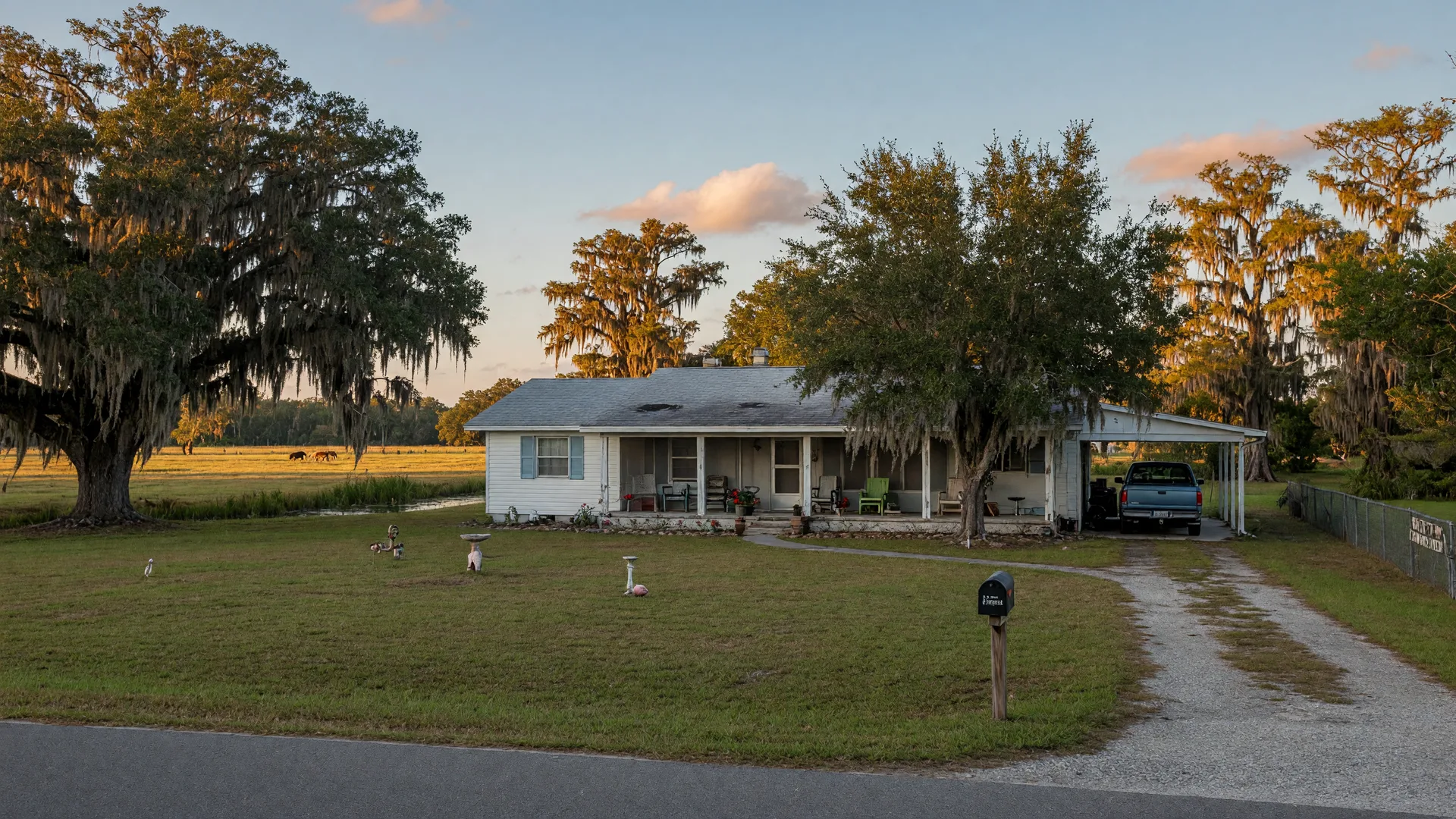
Two government-backed loan programs are the most common ways Florida buyers get into a home with little or no money down: the USDA loan and the FHA loan. A USDA loan lets eligible buyers finance 100% of the purchase price in rural and suburban areas of the state, while an FHA loan requires as little as 3.5% down and works anywhere in Florida. This guide compares both side by side using current program details, so you can see which one fits your credit, your savings, and the specific property you are considering.
I will be upfront about my role here: I am a mortgage loan originator, so helping buyers compare loan programs is part of my job, but my goal is not to steer you toward one product. It is to make sure you understand the trade-offs. The USDA and FHA programs look similar at first glance, both government-backed with low down payment requirements, but they differ in ways that matter: where the property can be, what your income can be, what credit score you need, and what you pay in fees over the life of the loan.
Here is what we will cover: the short version of each program, where USDA loans actually work in Florida and where they do not, how FHA compares, a dollar-by-dollar fee comparison on a real purchase, and a clear guide to which loan fits which buyer.

The Short Version: USDA vs. FHA in Florida
Here are the two programs side by side before we dig into the details:
USDA Loan
Zero down, area and income limited
- Zero down payment, 100% financing
- Property must be in a USDA-eligible area
- Household income limit applies
- Most lenders want a 640 credit score
- 1% upfront fee plus 0.35% annual fee
- 30-year fixed available
FHA Loan
3.5% down, works anywhere
- 3.5% down with a 580 credit score
- No location restriction, any Florida county
- No income limit
- Credit scores from 500 with 10% down
- 1.75% upfront fee plus 0.55% annual MIP
- 30-year fixed available
What Is a USDA Loan in Florida?
The USDA guaranteed loan, backed by the U.S. Department of Agriculture, is designed for low-to-moderate income buyers in rural and suburban communities. Its headline feature is the down payment: you can finance 100% of the purchase price, so no cash is required for a down payment at all. That makes it the closest thing Florida has to a true zero-down conventional-style path for buyers who are not veterans, since VA loans are the other big zero-down option but require military service.
In exchange for that zero-down benefit, the program has two real constraints. First, the property must sit inside a USDA-designated eligible area, which the agency defines address by address rather than by county or ZIP code. Second, your total household income must stay within the program's limits, which are set at 115% of the area median income for your county and household size. For 2026 the national standard is about $122,800 for a one-to-four-person household, with higher ceilings in high-cost South Florida counties, so the exact number depends on where you buy.
The USDA program does not set a hard minimum credit score, but in practice most lenders use a 640 as the floor for automated approval. Borrowers in the 620 to 639 range can sometimes qualify through manual underwriting with stronger compensating factors. Instead of private mortgage insurance, USDA loans carry a 1% upfront guarantee fee, typically financed into the loan, plus a 0.35% annual fee on the average loan balance paid monthly. For the full rundown on how the program works, see our USDA loan page.
Where USDA Loans Work in Florida (and Where They Do Not)
This is the part that surprises most Florida buyers. USDA eligibility is about the specific address, not the county you think you are buying in. The map generally covers communities under about 10,000 people, with exceptions for larger areas that lack mortgage credit, and roughly 73% to 80% of Florida sits inside USDA-eligible boundaries. The dense urban cores of the big metros do not qualify, but plenty of suburban-edge and small-town Florida does.
In South Florida specifically, the picture breaks down like this:
- Western Palm Beach County is broadly eligible. Communities like The Acreage, Loxahatchee Groves, Belle Glade, Pahokee, and South Bay all fall inside USDA-eligible boundaries, which is why this is the main South Florida area where a zero-down USDA loan is a realistic option.
- Miami-Dade County is essentially not eligible. Even the rural southern portions generally fall outside the USDA map, so buyers there typically turn to FHA, conventional, or VA financing.
- The Florida Keys, Monroe County, are also essentially not eligible. If you are set on buying in Key Largo, Islamorada, or Marathon, a USDA loan is usually not the path.
The lesson is to check the property before you fall in love with the financing. You can pull up the official USDA eligibility map and enter an address to see whether it qualifies, and a lender who works with the program regularly can confirm it for you. Eligibility is checked against the property, so two homes a mile apart can have different answers.
How FHA Loans Compare: A Lower Credit Bar and Location Freedom
FHA loans, backed by the Federal Housing Administration, are the most popular low-down-payment option in Florida for a simple reason: they work everywhere and accept almost anyone. There is no location restriction, so an FHA loan works for a condo in Miami, a townhome in Fort Lauderdale, or a house in West Palm Beach. There is also no income limit, which matters for buyers whose household income clears the USDA cap.
The trade-off is the down payment and the credit bar. FHA requires 3.5% down with a credit score of 580 or higher, and 10% down if your score lands between 500 and 579. Borrowers below 500 generally cannot qualify for FHA. The down payment can come partly from gift funds, which makes it more reachable for first-time buyers, and our gift money guide walks through those rules.
FHA also carries mortgage insurance in two parts: an upfront premium of 1.75% of the loan amount, usually financed into the loan, and an annual premium that at 3.5% down on a 30-year loan runs 0.55% of the balance, paid in 12 monthly installments for the life of the loan. Put 10% or more down and the annual premium drops to 0.50% and is cancelled after 11 years. For the details on the program itself, see our FHA loan page.
The Fee Comparison on a Real Florida Purchase
Estimates only make sense when you can see them on an actual house, so here is a realistic example: a $350,000 home in a USDA-eligible area of western Palm Beach County, financed with a 30-year fixed rate in the current late-2026 Florida environment, which is sitting around 6.7% to 6.8%. These are estimates for education, not a quote from any lender. Your numbers will come from your actual Loan Estimate.
USDA Loan
$350,000 Home, 0% Down
Down payment
$0
Upfront guarantee fee (1%, financed)
Approximately $3,500
Total financed
Approximately $353,500
Annual fee (0.35%, for the life of the loan)
Roughly $1,200 in the first year, paid monthly
Monthly principal and interest
About $2,300, before taxes and insurance
FHA Loan
$350,000 Home, 3.5% Down
Down payment
$12,250
Upfront MIP (1.75%, financed)
Approximately $5,910
Total financed
Approximately $343,660
Annual MIP (0.55%, for the life of the loan)
Roughly $1,860 a year, paid monthly
Monthly principal and interest
About $2,230, before taxes and insurance
Here is the part most buyers miss. Zero down does not mean the loan is cheaper. The USDA loan finances the full $350,000 plus its 1% fee, so you start owing about $353,500. The FHA loan starts at about $343,660 because you brought $12,250 to the table, even after financing its higher 1.75% upfront fee. Over time, USDA carries the lower ongoing fee, 0.35% versus 0.55% for FHA at the 3.5% down level.
So the real question is not which monthly number is lower, because they land close together, it is whether keeping that $12,250 in your savings account matters more to you than starting with a slightly larger loan balance. Both programs charge their mortgage insurance or guarantee fee for the life of the loan at this down payment level, so neither is something you simply drop once you build equity. If removing mortgage insurance early matters to you, a conventional loan is the program that allows that, and our FHA vs. conventional vs. VA comparison lays out the full picture.
Which One Fits You: USDA or FHA?
The honest answer is that it depends on three things: where the property is, what your household income is, and where your credit score lands. Here is how I walk buyers through the decision:
- Choose USDA when the property is in an eligible area, your income is within the limits, and your credit is around 640 or better. Zero down keeps the most cash in your pocket, and the annual fee is lower than FHA's.
- Choose FHA when your credit is below 640, your income is over the USDA cap, or the property you want is not USDA-eligible, which covers most of South Florida's urban and coastal markets, including Miami-Dade and the Keys.
- Choose FHA when you want flexibility. If you are still deciding between areas, or you want to buy a condo, FHA's lack of a location restriction gives you more room to move.
Both programs are excellent for first-time buyers, and if you are weighing everything at once, our first-time homebuyer guide is a good place to start.
How to Check Whether a Florida Property Is USDA-Eligible
Checking eligibility is the first step, and it takes about a minute. Use the official USDA eligibility map and enter the property's address, not the county or ZIP code. Because about a quarter of Florida sits outside the map, and the urban cores of Miami-Dade, Broward, and the Keys are the big exceptions, you want an address-level answer rather than a guess.
Next, run the income check against the USDA income limits for that county and your household size. If the property is eligible and your income fits, the loan itself is very doable, and a lender who closes USDA loans regularly can handle the underwriting. If the property does not qualify, an FHA loan is usually the natural fallback, and we can compare both with real numbers before you commit to either.
Frequently Asked Questions
Can I use a USDA loan to buy in the Florida Keys?
Generally no. Monroe County has essentially no USDA-eligible areas, so a purchase in Key Largo, Islamorada, or Marathon would normally use FHA, conventional, or another program. Austin can run the numbers for a specific Keys address to confirm.
Is a USDA loan better than an FHA loan in Florida?
It depends on where the property is, your household income, and your credit score. USDA wins on zero down and a lower ongoing fee, but only in eligible areas with income limits. FHA wins on location freedom and a lower credit bar. Neither is better across the board, one simply fits your situation.
What credit score do I need for a USDA loan in Florida?
The USDA does not set a hard minimum, but most lenders use 640 as the floor for automated approval. Scores in the 620 to 639 range can sometimes qualify through manual underwriting. For comparison, FHA accepts 580 with 3.5% down.
How much money do I need to put down for a USDA loan?
Zero. The USDA guaranteed loan finances 100% of the purchase price. You still cover closing costs and prepaids, and the 1% upfront guarantee fee is typically financed into the loan, which is why the starting balance runs slightly above the purchase price.
Do USDA loans have mortgage insurance?
Yes, of a sort. Instead of private mortgage insurance, USDA loans carry a 1% upfront guarantee fee plus a 0.35% annual fee on the average loan balance, paid monthly. Like FHA mortgage insurance at a low down payment, the USDA annual fee continues for the life of the loan.
Are there income limits for USDA loans in Florida?
Yes. Household income must stay within 115% of the area median for your county and household size. The 2026 national standard is about $122,800 for a one-to-four-person household, with higher limits in high-cost South Florida counties. FHA has no income limit at all.
The Bottom Line on USDA vs. FHA in Florida
Both the USDA and FHA loans are powerful low-down-payment tools, and the right one depends on three things: where the property is, what your household income is, and where your credit score lands. USDA offers the rare zero-down path in eligible areas like western Palm Beach County, but it comes with location and income limits and a slightly larger starting balance. FHA offers 3.5% down almost anywhere in Florida with a lower credit bar, at the cost of a larger ongoing premium.
The way to avoid guessing wrong is to check USDA eligibility for your target property, run the income limits, and compare real numbers from both programs side by side. That is exactly the kind of comparison an educated buyer makes before signing, and it is what I help Florida borrowers do every week.
Zero-down financing sounds like a free pass, but the math is more honest than that. USDA keeps cash in your pocket and finances its fee into the balance; FHA asks for a small down payment but a bigger ongoing premium. Neither is better, one just fits your credit, income, and property better.
Austin Edwards, Mortgage Loan Originator

Austin Edwards
Mortgage Loan Originator · NMLS #2639747
Austin helps Florida homebuyers understand their options and make confident mortgage decisions. He believes an educated buyer makes better financial choices.
Not sure whether USDA or FHA fits your Florida purchase?
Every deal is different. Austin can check whether your target property is USDA-eligible, run the income limits, and compare real numbers from both programs so you pick the loan that keeps the most money in your pocket. No commitment, no pressure.
Ask Austin a QuestionReady to compare your real numbers?
The fastest way to know which loan fits is a quick conversation and a real Loan Estimate from a lender you can trust.