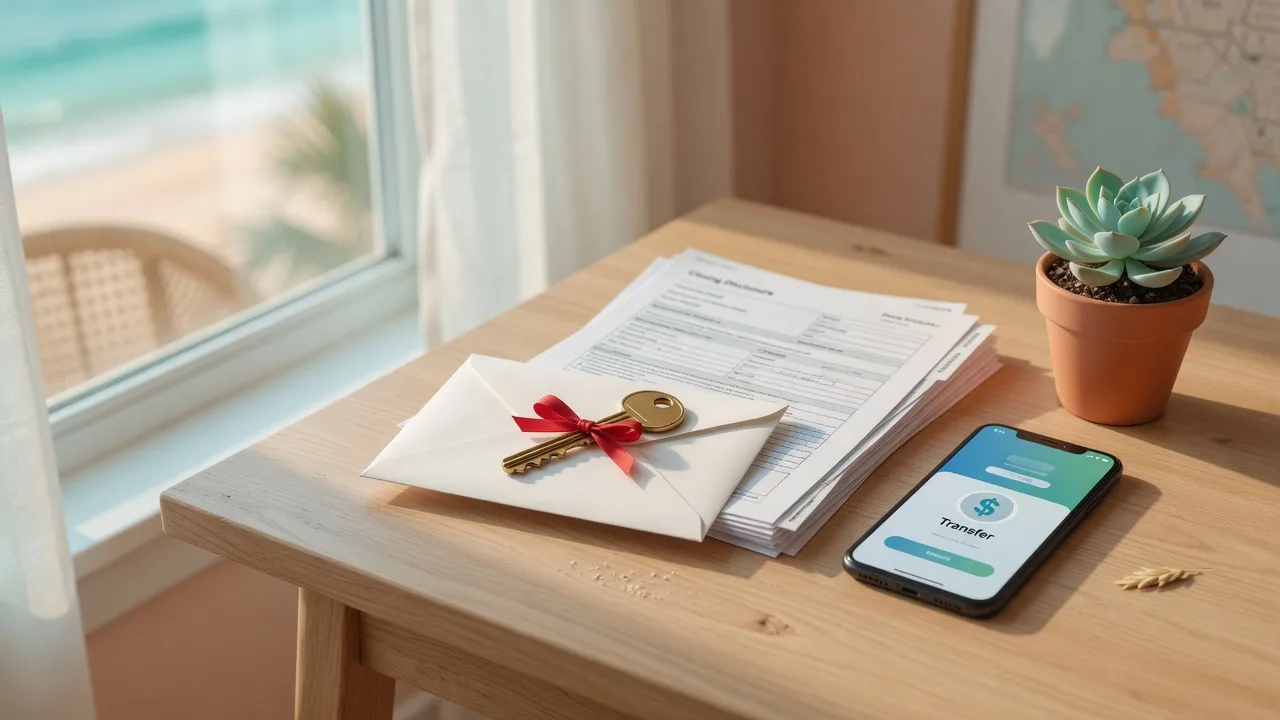
Yes, you can use gift money for a down payment in Florida, and millions of buyers do it every year with help from parents, grandparents, and other family members. The catch is that mortgage lenders treat gift funds carefully, and the rules are specific about who can give, what the paperwork has to say, and how the money has to be traced.
Here's the short version: gift money can cover your entire down payment on most FHA and conventional loans for a primary residence, it cannot come from the seller, the builder, the real estate agent, or your lender, and it has to be a true gift, meaning nobody expects you to pay it back. If the money is actually a loan from family, it gets treated like a loan, and that changes your numbers.
In this guide I'll walk you through the gift rules for FHA, conventional, and VA loans, exactly what a gift letter needs to say, how lenders verify where the money came from, and the mistakes that delay or kill gift-funded closings in Florida markets like Miami-Dade, Broward, Palm Beach, and the Keys.
Which Loans Let You Use Gift Money?
Almost every major program for owner-occupied homes allows gift funds. Here's how they treat them:
- FHA loans: Gifts may cover all or part of the down payment and closing costs, and FHA does not require you to put any of your own money into the down payment.
- Conventional loans (Fannie Mae and Freddie Mac): Gifts may fund the down payment, closing costs, and even financial reserves on a primary residence or second home. For a one-unit primary residence on a Fannie Mae loan, there is no minimum amount you have to contribute from your own funds, so your whole down payment can be a gift.
- VA and USDA loans: Both allow gift funds, and since VA and USDA loans can be done with zero down, gifts are typically used for closing costs and prepaids instead.
The big exception: investment properties. Gift funds are generally not allowed on rental or investment properties under FHA, Fannie Mae, or Freddie Mac rules. If you're buying a second home or an income property, plan on using your own documented funds.
Who Can Give You a Down Payment Gift?
The acceptable donor list is broader than most people think, but it's not unlimited. Under FHA rules, a gift can come from a family member (which includes parents, grandparents, siblings, aunts, uncles, in-laws, and others related by blood, marriage, adoption, or foster care), your employer, a labor union, a close friend with a clearly defined and documented interest in your life, a charitable organization, or a government agency with a homeownership program. Fannie Mae and Freddie Mac focus on relatives by blood, marriage, adoption, or legal guardianship, plus domestic partners, fiancés, and trusts or estates set up by an acceptable donor.
The most important rule is who can't give: the seller, the builder, the real estate agent, the title company, your lender, or anyone else with a financial stake in the transaction. Money from those parties is not a gift, it's a seller concession or a rebate, and it follows different rules. This trips up Florida buyers every year, especially in transactions where a relative happens to be the listing agent. The mortgage industry protects that line carefully, so don't blur it.
How Much of the Down Payment Can Be a Gift?
On an FHA loan with a 3.5% down payment, the gift can cover the entire amount. On a Fannie Mae conventional loan for a one-unit primary residence, the same is true, so a buyer putting down 3% can gift the whole thing. The rules tighten for conventional loans on second homes and two-to-four-unit properties, where lenders typically want at least 5% of the down payment to come from your own funds.
Freddie Mac rules also expect borrowers putting down less than 20% to bring some of their own money to the table in certain cases, so the exact requirement depends on the loan program you choose. Your loan officer should flag this early, before you sign anything, so there are no surprises about what counts as your funds.
To put it in dollars: a $400,000 home in a market like Tampa or Orlando needs $12,000 at 3% down, or $14,000 at 3.5% down. In pricier markets like Miami-Dade, Palm Beach, or Key Largo, the same percentages on a $700,000 purchase come to $21,000 and $24,500. For many first-time buyers those numbers are exactly where a parent or grandparent's gift makes the difference between buying this year and waiting another few years.
The Gift Letter: The One Document You'll Definitely Need
Every lender, on every program, requires a signed gift letter from the person giving the money. It's a short document, usually one page, and it has to state:
- The donor's name, address, and phone number
- The exact dollar amount of the gift
- The date the funds were transferred
- The donor's relationship to you
- The property address (or a statement that the property hasn't been selected yet in some cases)
- A clear statement that the money is a gift and no repayment is expected
The letter has to be signed and dated by the donor, not typed by you on their behalf. If the person giving the money lives out of state, which is common when parents in the Northeast or Midwest are helping a child buy in Florida, a signed scan or photo of the letter is fine. Your lender will give you the exact format they need, so don't worry about getting it perfect on the first try.
How Lenders Verify Where the Money Came From
A gift letter alone is not enough. Lenders have to prove the money is real and that it's actually a gift, which means building a paper trail. Typically the lender wants to see:
- The donor's bank statements showing the funds existed before the transfer
- Proof the money moved, like a withdrawal from the donor's account and a matching deposit into yours, or a wire transfer receipt
- Your own bank statements showing the money sitting in your account
This is where undocumented deposits become a problem. Underwriters review your bank statements and flag any deposit that stands out, usually anything in the range of half a month's income or more. If a large deposit can't be explained as payroll, a reimbursement, or a documented gift, the lender has to assume it could be an undisclosed loan, and an undisclosed loan is a deal breaker. It's not that lenders are suspicious of you personally, it's that they have to account for every significant dollar on the statements they underwrite.
There's a small shortcut worth knowing: if the gift money has sat in your account for roughly 60 days or more before you apply, many lenders treat it as seasoned savings and may not require the donor's statements, just the gift letter. If the money arrives right before closing, expect the full paper trail. Either way, tell your loan officer about the gift before the money moves. A five-minute conversation can save you a week of scrambling.
Mistakes That Delay or Derail a Gift-Funded Closing
Gift money is one of the most common reasons first-time buyers can buy at all, and also one of the most common reasons closings get pushed back. The patterns are almost always the same:
- Moving the money before telling your lender. Large unexplained deposits create work for the underwriter. Disclose the gift first, then move the funds.
- Calling it a gift when it's really a loan. If your parents expect repayment, it's a debt. A true gift expects no repayment, and promising to pay it back while documenting it as a gift puts your approval at risk. A family loan can work, but it has to be documented as a loan and the payment counts against your debt-to-income ratio.
- Gifts from the wrong person. A buyer who receives $20,000 from a close friend they met through a work connection might find a Fannie Mae loan won't accept it, since the rules favor family and documented relationships. FHA is a bit more flexible here, but confirm the donor qualifies before you count on the money.
- Skipping the source documents. The donor needs to show where their money came from. If your parents "kept cash in a drawer" for years, that's hard to document, and lenders need to see funds in an account.
- Gift money mixed with borrowed cash. If the donor's gift includes money they themselves borrowed, lenders will want to trace the deposit that funded the gift. Keep the source clean and simple.
Every one of these is fixable, but fixing them takes time, and in a competitive market that time can cost you the contract. The fix is boring and simple: talk to your loan officer before any money changes hands.
Gift Money in Florida's Coastal Markets
Gift funds matter most where down payments are the biggest, and Florida has plenty of those markets. A first-time buyer in Miami-Dade or Fort Lauderdale is working with six-figure price tags in many neighborhoods, and a Palm Beach or Florida Keys purchase can push well beyond that. In those markets, a parent's gift of $30,000 or $40,000 can be the single factor that turns a pre-approval into a signed contract.
Fall and winter are also the seasons when out-of-state buyers pour into South Florida and the Keys, often with family help from up north. If you're coordinating a gift from out of state, give yourself extra time for the wire and the paperwork. A wire between banks usually lands within a day, but a mailed check has to clear, and the 60-day seasoning window doesn't start until the funds are in your account.
One more Florida-specific note: a family gift is not the same thing as down payment assistance. Programs like FL Assist and FL HLP from Florida Housing are deferred second mortgages or loans, not gifts, and they have their own income limits, purchase price caps, and paperwork. You can sometimes pair a family gift with a down payment assistance program, but not every combination is allowed on every loan, so run the full plan past a lender who knows both sets of rules before you commit.
Frequently Asked Questions
Can my parents give me money for a down payment in Florida?
Yes. Parents are the most common gift donors in mortgage lending. On an FHA loan, a gift from your parents can cover your entire 3.5% down payment plus closing costs. On a Fannie Mae conventional loan for a one-unit primary residence, the full down payment can be a gift too.
Do I still need a gift letter if the money is already in my account?
Almost always, yes. If the money came from a gift, the lender needs the signed gift letter regardless of how long it's been in your account. If the money has been there for roughly 60 days or longer, many lenders will accept the letter without also pulling the donor's bank statements.
Can a friend gift me money for a down payment?
It depends on the loan. FHA allows gifts from a close friend with a clearly defined and documented interest in the borrower. Conventional loans from Fannie Mae and Freddie Mac generally limit donors to family relationships, domestic partners, and fiancés, so a gift from an unrelated friend usually won't qualify. Check with your loan officer before building your plan around it.
Will gift money raise my interest rate or hurt my approval?
No, as long as it's documented properly. A clean, well-documented gift is a normal part of countless Florida mortgage approvals, and it doesn't change your rate or your qualification. The problems come from large deposits that can't be explained, which underwriting may treat as an undisclosed loan. Disclose the gift up front and provide the letter and source documents, and you're in good shape.
Do I owe taxes on a down payment gift?
A down payment gift is not taxable income to you, the buyer. The person giving the gift is the one who might need to file a gift tax return, and only if the gift exceeds the annual gift tax exclusion. Most parents and grandparents who help with a down payment stay well under that limit. It's still worth a quick conversation with a tax professional if the gift is unusually large.
What if the money from my family is a loan, not a gift?
Then it has to be documented as a loan, with a signed note, and the monthly payment counts in your debt-to-income ratio, which affects how much house you can afford. Never document a loan as a gift. A lender who sees a repayment agreement for "gifted" funds is looking at a much bigger problem than a slightly higher debt ratio. Be upfront and we'll figure out the correct structure.
Final Thoughts
Gift money is one of the most powerful tools a first-time buyer has, and in Florida's coastal markets it's often the difference between renting another year and owning now. It's also one of the easiest things to get wrong, because the rules live in lender guidelines that most people have never read.
My advice is simple: before anyone sends you a dollar, call a lender you trust, tell them about the gift, and ask exactly what documentation they'll need. A five-minute conversation now saves you from a frantic week at the end of your 30-day closing window, and it keeps the money in the right structure from day one.
My job isn't to sell you a mortgage. It's to help you understand your options, avoid costly mistakes, and choose the financing strategy that truly fits your goals.
Austin Edwards, Mortgage Loan Originator

Austin Edwards
Mortgage Loan Originator · NMLS #2639747
Austin helps Florida homebuyers understand their options and make confident mortgage decisions. He believes an educated buyer makes better financial choices.
More Resources
Looking for more mortgage guidance? Read the Florida down payment assistance guide to compare state programs with family gifts, browse the blog index for more articles, or reach out to Austin directly with your questions.
Have a question? Ask Austin.
Every borrower's situation is different. If someone in your family is planning to help you buy, Austin would love to walk you through the gift rules for your specific loan. No commitment, no sales pitch. Just a straight answer.
Ask Austin a QuestionPlanning to use gift money for your Florida home?
Austin will help you document the gift correctly, confirm who's allowed to give, and make sure the money is structured so your closing goes smoothly. No pressure. Just honest guidance.