Closing costs in Florida in 2026 usually land between 2% and 5% of the purchase price, with the statewide average running closer to 2.3%. On a $400,000 home, that means roughly $9,000 on top of your down payment. This guide breaks down every major fee you will see at the closing table, in real dollars, so a surprise bill at the end does not derail your purchase.
I will be straight with you about my role here: I am a mortgage loan originator, so helping buyers plan for closing day is part of my job, but it is not about collecting fees. Florida has some costs that other states do not, especially its documentary stamp taxes, and most buyers are caught off guard by them the first time. My goal is to make sure you walk in knowing what each charge is, why it exists, and whether anyone can negotiate it.
Here is what we will cover: the big closing-cost number in Florida, the state taxes that make this state different, title insurance and the standard fee stack, real dollar examples at three price points, who pays what, and how to reduce what you owe.
Closing Costs in Florida: The Big Number
Start with the rule of thumb so you have a target. Typical buyer closing costs in Florida run about 2% to 5% of the purchase price, and most estimates put the statewide average near 2.3%. On Florida's median-priced single-family home, which sold for about $415,000 in August 2026, that works out to roughly $8,500 to $9,500, separate from your down payment.
Three things push that number up or down: where in Florida you buy, because local taxes and fees vary by county, whether you are buying a single-family home or a condo, and the loan amount, since several state charges are calculated off the size of your mortgage. A $300,000 condo in Miami-Dade and a $300,000 house in the Panhandle can have meaningfully different closing bills.
And an important note before we go further: closing costs are not the same as your down payment, and they are not the same as prepaid items like property taxes and insurance that get collected into escrow. Each plays a different role, and lumping them together is how budgets get blown. We will untangle all of it below.
The State Taxes That Make Florida Different
Florida does not have a state income tax, but it makes up for it at the closing table with two taxes you will see on nearly every purchase: the documentary stamp tax and the intangible tax. If you are new to Florida, these are almost certainly not on your radar, and they are the most common surprise I hear about.
The documentary stamp tax on the promissory note is $0.35 per $100 of the loan amount, and it is always the buyer's responsibility. On a $320,000 mortgage, that is $1,120. Florida also charges a nonrecurring intangible tax on the mortgage of $2 per $1,000 of the loan, which adds another $640 on that same loan. Together, the two state taxes on the note come to roughly $1,760 on a $320,000 loan.
There is also a documentary stamp tax on the deed, at $0.70 per $100 of the purchase price in most counties, calculated on the full sale price rather than the loan. In Miami-Dade the rate is $0.60 per $100 on single-family homes, with an added surtax on non-single-family transfers. The good news for most buyers: in the customary Florida transaction, the seller pays the deed stamps. You will still see the line item, but you are usually not the one writing that check.
Title Insurance: A Florida Fixed Cost
Title insurance protects you against problems with the title, like a hidden lien or an old claim against the property. Florida sets these rates by state regulation, which means they are identical at every title company in the state, so shopping around will not change the premium itself. The owner's policy runs $5.75 per $1,000 of coverage on the first $100,000, then $5.00 per $1,000 up to $1 million.
In real dollars, an owner's title policy costs about $575 on a $100,000 home, $1,575 on a $300,000 home, and $2,575 on a $500,000 home. The lender's policy, which protects the bank, is typically only about $25 extra when it is issued at the same time. Because these rates are state-fixed, the main thing you control is whether you have a recent prior owner's policy that qualifies for a lower reissue rate, and your closing agent or lender can check that for you.
The Standard Fee Stack: Appraisal, Credit, Recording, and More
Beyond the state taxes and title insurance, every Florida purchase carries a stack of standard service fees. These are the ones buyers recognize from other states, but the dollar amounts are worth planning for:
- Appraisal: typically $400 to $800, depending on your market and property type. Required on most loans to confirm the home is worth what you are paying.
- Credit report and mortgage fees: often a few hundred dollars combined, covering the lender's underwriting and processing work.
- Recording fees: usually $100 to $200, paid to your county to record the deed and mortgage.
- Settlement or closing fee: a few hundred dollars, paid to the title or closing agent who runs the closing.
- Survey, where required: often a few hundred dollars, and who pays it varies by county contract custom.
- Condo-specific items if applicable: HOA transfer fees, estoppel letters, and association application fees can add several hundred more, which is why condo purchases often close with a higher bill.
Real Dollar Examples at Three Price Points
Estimates only make sense when you can see them on an actual house, so here are three realistic examples built from Florida's current fees. All assume 20% down and are estimates for education, not a quote from any lender. Your numbers will come from your actual Loan Estimate.
Example: $300,000 Home, $240,000 Loan
Documentary stamp tax on the note ($0.35 per $100)
Approximately $840
Intangible tax on the mortgage ($2 per $1,000)
Approximately $480
Owner's title insurance (state-promulgated rate)
Approximately $1,575
Appraisal, credit, recording, and settlement fees
Approximately $1,300 to $1,700
Estimated total buyer closing costs
Roughly $4,200 to $4,600
Example: $400,000 Home, $320,000 Loan
Documentary stamp tax on the note ($0.35 per $100)
Approximately $1,120
Intangible tax on the mortgage ($2 per $1,000)
Approximately $640
Owner's title insurance (state-promulgated rate)
Approximately $2,075
Appraisal, credit, recording, and settlement fees
Approximately $1,400 to $1,900
Estimated total buyer closing costs
Roughly $5,200 to $5,700
Example: $600,000 Home, $480,000 Loan
Documentary stamp tax on the note ($0.35 per $100)
Approximately $1,680
Intangible tax on the mortgage ($2 per $1,000)
Approximately $960
Owner's title insurance (state-promulgated rate)
Approximately $3,075
Appraisal, credit, recording, and settlement fees
Approximately $1,600 to $2,100
Estimated total buyer closing costs
Roughly $7,300 to $7,800
Notice that these fall at the lower end of the 2% to 5% range, because they do not include prepaids like property taxes and homeowners insurance, which we cover next. They also assume the seller is paying the deed stamps under the usual Florida contract, and they do not count survey costs where those apply. On a condo, expect to add HOA transfer and estoppel fees.
Prepaids and Escrow Are Not Closing Costs
A big chunk of what you bring to closing in Florida is not a fee at all, it is prepaid money collected so your escrow account starts funded. You will typically prepay part of the first year's property taxes and homeowners insurance, and in flood zones, flood insurance, plus an escrow cushion that lenders are allowed to hold. In a state where insurance and taxes are this expensive, the prepaid total can rival your actual closing costs.
This is why the mortgage calculator on this site builds a full housing payment that includes principal, interest, property taxes, homeowners insurance, mortgage insurance, HOA dues, and flood insurance. If you budget only for the closing-cost line items and ignore the prepaids, you will be short at the table. Ask your lender for the prepaid estimate early so the full number is never a surprise.
What Buyers vs. Sellers Pay in Florida
Florida follows a customary split that surprises a lot of out-of-state buyers. Under the typical contract, the seller pays the documentary stamp tax on the deed, plus real estate commission and sometimes title insurance for the owner. The buyer pays the documentary stamp tax on the note, the intangible tax, the owner's and lender's title policies, and the lender and closing fees.
The practical result: a Florida buyer's closing bill is driven mainly by the loan amount, the state taxes on it, and title insurance, which is why higher-priced South Florida purchases like those in Miami-Dade, Broward, and Palm Beach come with bigger closing bills. And because the buyer carries the note taxes, a larger loan means a larger closing cost, no matter the home price.
How to Reduce Your Florida Closing Costs
Some closing costs are fixed by state law, but several are negotiable or avoidable, and a little planning goes a long way:
- Compare Loan Estimates from more than one lender. Fees in the lender's own column, like processing and underwriting, can vary by thousands between lenders for the same loan.
- Ask about seller concessions. In many 2026 Florida deals, buyers negotiate for the seller to contribute toward closing costs. There are limits based on your loan program, so check what your loan allows. Our guide to seller concessions walks through the rules.
- Time your application to reduce prepaids where you can, and ask your lender to walk you through which line items are negotiable. Nothing is negotiable if you never ask.
- Watch for a recent prior owner's title policy. A reissue rate can lower your owner's title premium.
- Do not pay points you do not need. Discount points lower your rate but add to your closing bill, so only buy them when the math favors your timeline.
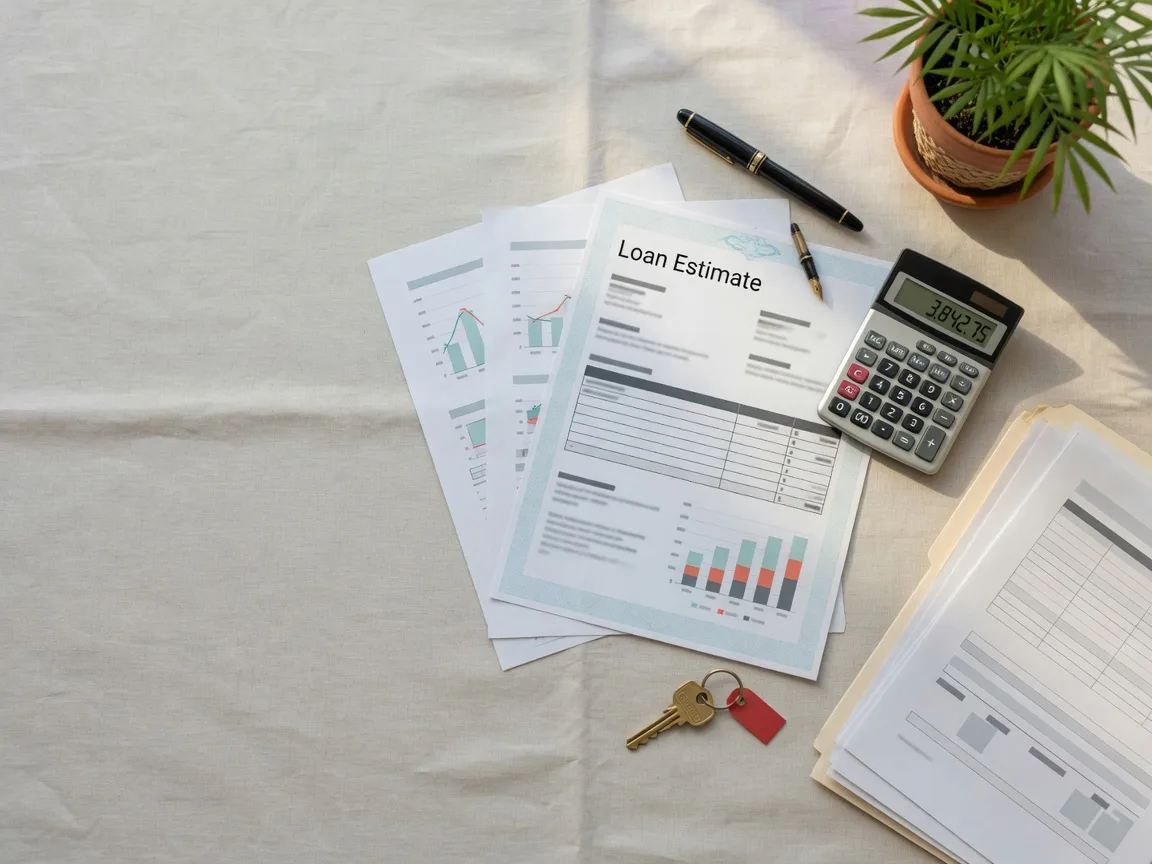
For a full line-by-line walkthrough of every charge on the document you will actually sign, see our guide to reading your Florida Loan Estimate. If you want the broader overview of what closing costs are and why they exist, our closing costs explainer covers the fundamentals.
When You Will See the Real Numbers
The closing-cost estimates in this article are a planning tool, not your final bill. Your lender is required to give you a Loan Estimate within three business days of your application, and that document lists your closing costs with a tolerance that limits how much the lender can change them. Then you receive a Closing Disclosure at least three business days before closing, which is your final, binding look at the numbers.
Use those two documents to compare apples to apples between lenders, and read the Closing Disclosure carefully against your Loan Estimate before you sign. If something changed and no one explained it, that is exactly the moment to stop and ask. A good loan originator will walk you through every line.
Frequently Asked Questions
How much are closing costs on a $300,000 house in Florida?
Plan on roughly $4,200 to $4,600 in closing costs, plus prepaids for property taxes and insurance. That estimate assumes 20% down on a $240,000 loan, includes about $1,575 for an owner's title policy, and does not count survey or condo fees. Your real number comes from your Loan Estimate.
Who pays closing costs in Florida, the buyer or seller?
Under the usual Florida contract, the seller pays the deed documentary stamps, commission, and often the owner's title policy, while the buyer pays the documentary stamp tax on the note, the intangible tax, the lender's title policy, and lender and closing fees. The exact split is spelled out in your contract and can be negotiated.
What is the Florida documentary stamp tax?
It is a state tax on the documents that transfer and finance property. The note tax is $0.35 per $100 of the loan amount and is paid by the buyer. The deed tax is $0.70 per $100 of the sale price in most counties and is customarily paid by the seller. There is also an intangible tax on the mortgage of $2 per $1,000 of the loan.
Can the seller pay my closing costs in Florida?
Yes, through seller concessions, and it is common in 2026. The catch is that each loan program caps how much the seller can contribute, typically 3% to 6% of the purchase price depending on your down payment and loan type. Concessions can cover closing costs and prepaids, but not your down payment on most programs. Our seller concessions guide details the limits.
Are property taxes and insurance part of closing costs?
They are collected at closing, but they are prepaids, not fees. You prepay part of the property taxes and homeowners insurance, plus flood insurance where required, so your escrow account starts funded. In Florida these prepaids can rival your actual closing costs, so budget for both lines separately.
Do closing costs change if I put less money down?
Somewhat, because the state note taxes and intangible tax are calculated off the loan amount, and a smaller down payment means a larger loan and slightly higher state taxes. You may also add private mortgage insurance and its upfront cost. The purchase price and title premium stay the same, so the total moves less than you might expect.
The Bottom Line on Florida Closing Costs
The honest answer to "how much are closing costs in Florida in 2026" is 2% to 5% of the purchase price, with the state average near 2.3%, plus prepaids that can be just as large. The breakdown is predictable: state note taxes, intangible tax, title insurance, and a standard stack of service fees, with a few dollars of negotiation room in the lender's own charges and real savings available through seller concessions.
The way to keep this from being a surprise is to get your Loan Estimate early, read it line by line, and compare it with another lender. A few thousand dollars in lender fees is real money, and it is exactly the kind of thing an educated buyer avoids.
Most of Florida's closing costs are set by state law or standard practice, but that does not make them a mystery. Know the dollar breakdown before you sign, compare lenders on the fees they control, and ask for the seller concessions your loan allows.
Austin Edwards, Mortgage Loan Originator

Austin Edwards
Mortgage Loan Originator · NMLS #2639747
Austin helps Florida homebuyers understand their options and make confident mortgage decisions. He believes an educated buyer makes better financial choices.
Want an exact closing-cost breakdown for your Florida purchase?
Every deal is different, and the real number comes from your loan amount, your county, and your property type. Austin can pull your Loan Estimate, walk you through every line item, and help you compare lenders so you do not overpay at the table. No commitment, no pressure.
Ask Austin a QuestionReady to see your real closing costs?
The fastest way to know what you will pay at the table is a quick conversation and a real Loan Estimate from a lender you can trust.