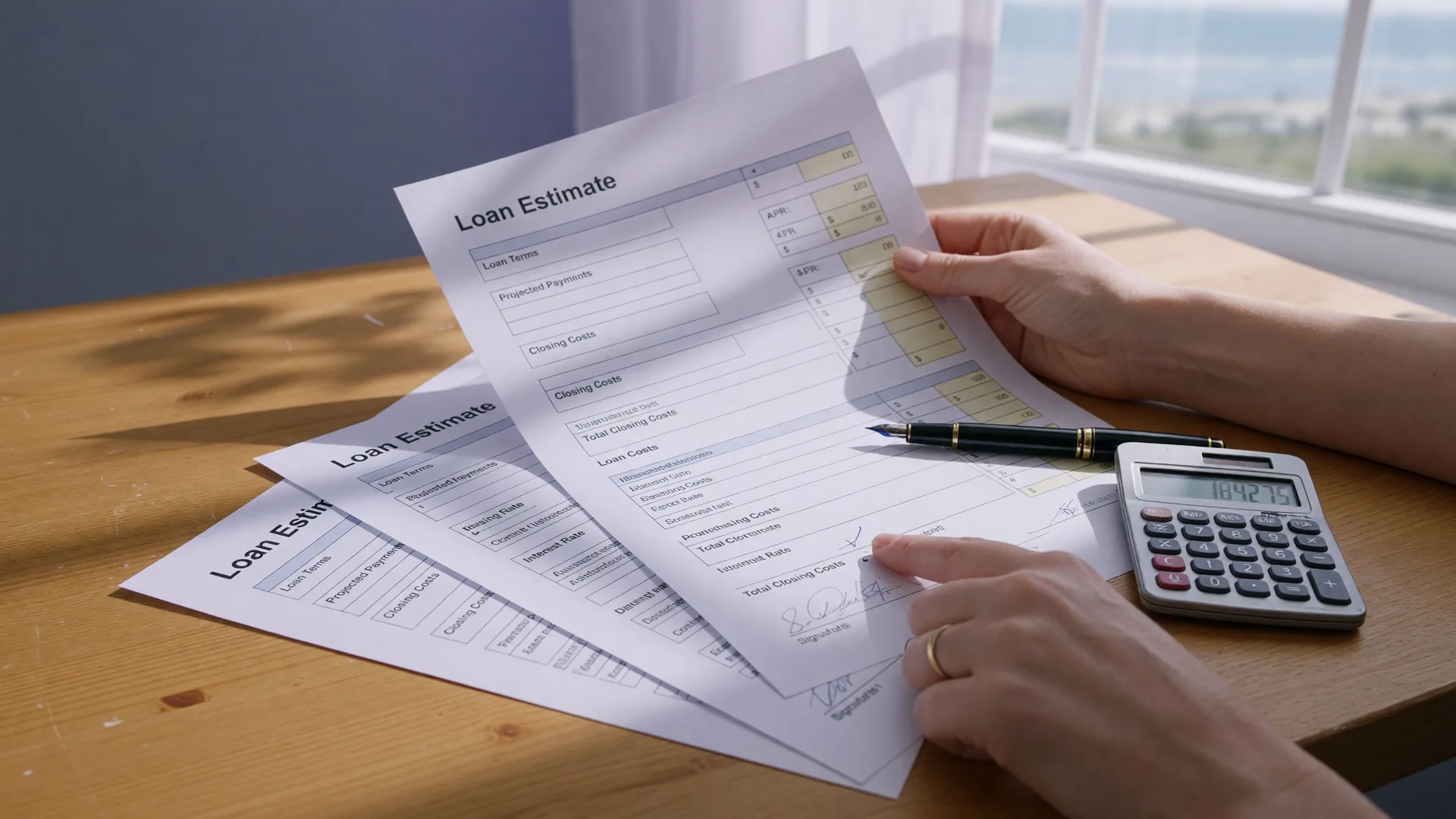
The Loan Estimate is the three-page document every Florida lender must give you within three business days of your application, and it is the single most important piece of paper in your mortgage. It spells out your rate, your monthly payment, and every closing cost in plain numbers, so you can compare offers and know exactly what you are signing up for before you commit. If you know how to read it, you will catch mistakes, compare lenders fairly, and avoid surprises at the closing table.
I tell borrowers the same thing I tell myself: the Loan Estimate is not fine print to skim, it is a checklist to work through. With 30-year rates sitting in the mid-to-high 6% range across Florida this September, and closing costs that typically run 2% to 3% of your purchase price, a few minutes spent understanding this document can save you thousands over the life of your loan.
Here is how to read every section, what Florida's specific fees look like, and where errors tend to hide.
What Is a Loan Estimate and Why Does It Matter?
A Loan Estimate, sometimes called the LE, is a standardized three-page form created by the Consumer Financial Protection Bureau. Because every lender uses the same format, you can put one next to another and compare them line by line, which is exactly what you should do when you are shopping. Lenders are required to give you a Loan Estimate within three business days of taking your application, and the numbers on it are the basis for the Closing Disclosure you will see near the end of your process.
The document is divided into two big buckets: Loan Costs, which are the fees to originate and process your loan, and Other Costs, which are taxes, insurance, prepaids, and escrow. Everything you pay at closing falls into one of those two groups, and the final page adds it all up into the cash you need to close.
The rate and payment on page one are where most buyers stop reading, and that is a mistake. Two lenders can quote the same 6.75% rate and still charge you very different amounts in fees, and those fees are what turn an advertised rate into a real cost. My job is to make sure you see the whole picture, not just the headline number.
The Three Pages of a Loan Estimate
Each page has a clear job. Page one shows your loan terms, your projected payment, and the cost at closing. Page two details every fee in the lettered sections. Page three summarizes your comparisons, other considerations, and the disclosures you need to acknowledge.
Page-by-Page Quick Map
Page 1: The Big Numbers
Loan amount, interest rate, monthly principal and interest, estimated total monthly payment, and cash to close.
Page 2: The Fee Detail
Sections A through H, the lettered breakdown of every closing cost and what you can and cannot shop for.
Page 3: Comparisons and Disclosures
APR, total interest paid, how long you plan to keep the loan, and the signed disclosures.
The single most important number on page one is not the interest rate, it is the Estimated Total Monthly Payment. In Florida that number includes not just principal and interest but property taxes, homeowners insurance, and often mortgage insurance, HOA dues, and flood insurance. That full payment is the real cost of owning the home, and it is the number your budget should be built around.
Section by Section: What Each Line Really Means
Page two is where the detail lives, and it is organized into lettered sections that are the same on every Loan Estimate. Here is what each one is actually telling you.
Section A: Origination Charges
This is what the lender charges to make the loan: origination fees, underwriting, processing, and any discount points you are paying to lower your rate. This is also the section where lender credits, like money the lender gives you in exchange for a higher rate, show up as a negative number. Origination charges typically run about 0.5% to 1.5% of your loan amount, though they vary widely by lender, and they are the most negotiable line on the whole document.
Section B: Services You Cannot Shop For
These are services the lender chooses, and you are not expected to price them yourself: the appraisal, a credit report, a flood determination, and sometimes a survey. The costs are generally set and similar across lenders, but it is still worth reading them, because they add up.
Section C: Services You Can Shop For
This is the section where a Florida buyer can actually save money. It includes the title search, the title settlement agent fee, and the lender's title insurance policy. These are services you are allowed to shop for on your own, and prices can differ meaningfully between providers. It is always worth asking your lender or real estate agent for recommendations, then getting a second quote, because title charges are often one of the largest chunks of a Florida closing.
Sections D through H: The Other Costs
Section D is simply the total of A, B, and C, your loan costs. Section E is taxes and other government fees, which in Florida includes the documentary stamp tax and intangible tax on your mortgage. Section F is prepaids, including your first year of homeowners insurance and any per-diem interest. Section G is the initial escrow deposit for property taxes and insurance, and Section H is other costs like HOA dues paid at closing.
Florida-Specific Fees to Watch For
Florida has a few fees you will not see in every state, and they can add a real amount to your closing costs. Knowing them by name means they will not surprise you when you see them on the document.
- Documentary stamp tax on the mortgage. Florida charges $0.35 per $100 of your new mortgage note, and the buyer pays it. On a $400,000 loan that is about $1,400, a meaningful line item.
- Florida intangible tax. A small tax of $0.002 per $1, or $2 per $1,000, on the mortgage. On that same $400,000 loan it is about $800. It is often paid out of your loan proceeds at closing.
- Recording fees. The county records your deed and mortgage, and Florida caps these by statute at roughly $10 for the first page and $8.50 for each additional page. Across all the documents you record, the total is often $200 to $500.
- Lender's title insurance. This protects the lender if a title problem comes up, and it is a standard cost on a Florida purchase. It is different from the owner's title policy, which the seller typically pays in most Florida counties.
- Prepaids and escrow. Because Florida property taxes and homeowners insurance can be substantial, expect to fund several months of escrow at closing, plus a full year of homeowners insurance premium up front.
The exact mix changes by county. A condo purchase in Miami-Dade, a waterfront home in Key Largo, and a new construction build in Broward can each show different recording fees, HOA line items, and insurance prepaids, which is why the Loan Estimate is so useful: it turns the local specifics into one clear list.
How Much Are Closing Costs in Florida in 2026?
A common rule of thumb is that closing costs run about 2% to 3% of your purchase price, and Florida tends to land slightly above the national average because of its state taxes and insurance costs. On a $400,000 home, that is often $8,000 to $12,000 in the buyer's closing costs, before you count your down payment. Florida's lack of a state income tax is a real advantage, but the transfer and intangible taxes on a mortgage still show up at the closing table.
Your actual number depends on your loan amount, your county, whether you are buying points, and how much you prepay into escrow. That is why a good rule is to plan for roughly 3% of the purchase price in closing costs and be pleasantly surprised when the number comes in lower. You can get a more exact figure for your situation with the full-payment mortgage calculator, which builds in Florida taxes, insurance, and flood coverage.
Common Errors to Check Before You Close
Loan Estimates are full of moving parts, and small errors happen. A few minutes checking these five things will catch most of them:
- Your name and the property address. A misspelled name or a wrong parcel can delay your closing, so verify these first.
- The loan amount and rate match what you discussed. Make sure the rate, points, and loan type on page one are exactly what your loan officer quoted.
- The monthly payment includes everything. Confirm taxes, insurance, HOA, and flood insurance are in the total, not missing from it.
- Section A fees look reasonable. A sudden jump in origination or processing fees is worth a question, especially if another lender quoted lower.
- You actually asked for everything that is there. If you see points, a rate lock fee, or an escrow waiver you did not request, ask why it is on the document.
If something looks wrong, do not sign and hope it sorts itself out. Ask your loan officer to explain every line, and get corrections in writing. The whole point of the Loan Estimate is transparency, and any good lender, including me, wants you to understand it before you move forward.
From Loan Estimate to Closing Disclosure
Near the end of your process, your lender sends a Closing Disclosure, the final version of your costs. Compare it directly to your Loan Estimate. Most fees should be close to what you were quoted, and there are rules limiting how much certain fees can change between the two documents. If you see a big jump, ask about it before you close, because after signing, some changes are much harder to undo.
By law you receive the Closing Disclosure at least three business days before closing, which is your window to review it carefully. Read it the same way you read the Loan Estimate, line by line, and do not feel rushed. For a fuller look at the difference between buying and borrowing costs, see my guide to where your closing costs actually go and how seller credits in Florida can offset some of these numbers.
Frequently Asked Questions
When do I receive a Loan Estimate?
Your lender must give you a Loan Estimate within three business days of taking your mortgage application. You should receive it before you are asked to pay anything beyond a small application fee, and you are free to shop it against offers from other lenders.
What are typical closing costs in Florida?
Florida buyers typically pay about 2% to 3% of the purchase price in closing costs. On a $400,000 home that is often $8,000 to $12,000, before your down payment. Florida tends to run slightly above the national average because of state documentary and intangible taxes plus insurance prepaids.
What is the difference between a Loan Estimate and a Closing Disclosure?
The Loan Estimate is your good-faith quote early in the process, used to compare lenders. The Closing Disclosure is the final, near-final version of your costs, which you receive at least three business days before closing. Compare the two line by line, and question any fee that jumped between them.
What does the documentary stamp tax cost in Florida?
Florida charges $0.35 per $100 of the mortgage note, paid by the buyer. On a $400,000 loan that is roughly $1,400. There is also a small intangible tax of about $2 per $1,000 on the mortgage, and recording fees capped by statute, so together these state costs can add a few thousand dollars to a Florida closing.
Can I shop for title services in Florida?
Yes. Title search, settlement, and lender's title insurance fall in Section C of the Loan Estimate, the services you are allowed to shop for. Prices vary between providers, so it is worth getting more than one quote. In most Florida counties the seller pays the owner's title policy, but the buyer pays the lender's policy.
Does the Loan Estimate include property taxes and insurance?
It should. The Estimated Total Monthly Payment on page one includes principal, interest, taxes, and insurance, plus mortgage insurance, HOA, and flood insurance where they apply. Because Florida taxes and insurance are high, check that the total reflects your real numbers and not a low placeholder.
The Bottom Line on Reading Your Loan Estimate
The Loan Estimate is the clearest window you have into what a mortgage actually costs, and it was designed so you can compare lenders honestly. Read it line by line, check the full monthly payment, know Florida's state fees, and never hesitate to ask what any number means.
An educated buyer makes better financial decisions, and that starts with understanding the document in your hands. Whether you are buying your first home in Tampa, refinancing in Palm Beach, or financing a second home in the Florida Keys, the same skill applies: read the estimate, ask the questions, and know your numbers before you sign.
The advertised rate is a headline. The Loan Estimate is the full story. If you read only the headline, you will miss the fees, the taxes, and the insurance that make up the real cost of your home.
Austin Edwards, Mortgage Loan Originator

Austin Edwards
Mortgage Loan Originator · NMLS #2639747
Austin helps Florida homebuyers understand their options and make confident mortgage decisions. He believes an educated buyer makes better financial choices.
More Resources
Dive deeper into what you will pay with the full closing costs breakdown, learn how seller concessions can offset costs, and see how today's rate environment affects buying power. For a complete list of your options, visit the loan programs page.
Not sure what a fee on your Loan Estimate means? Ask Austin.
Every line on your estimate should make sense before you sign. Austin can walk you through your specific document, explain each fee, and help you compare it against other offers, so you close with confidence instead of confusion.
Ask Austin a QuestionWant to see your real numbers, not an estimate?
The best way to understand your closing costs is to see them on your own Loan Estimate. Austin will run your numbers, walk you through every line, and help you compare your options before you commit.