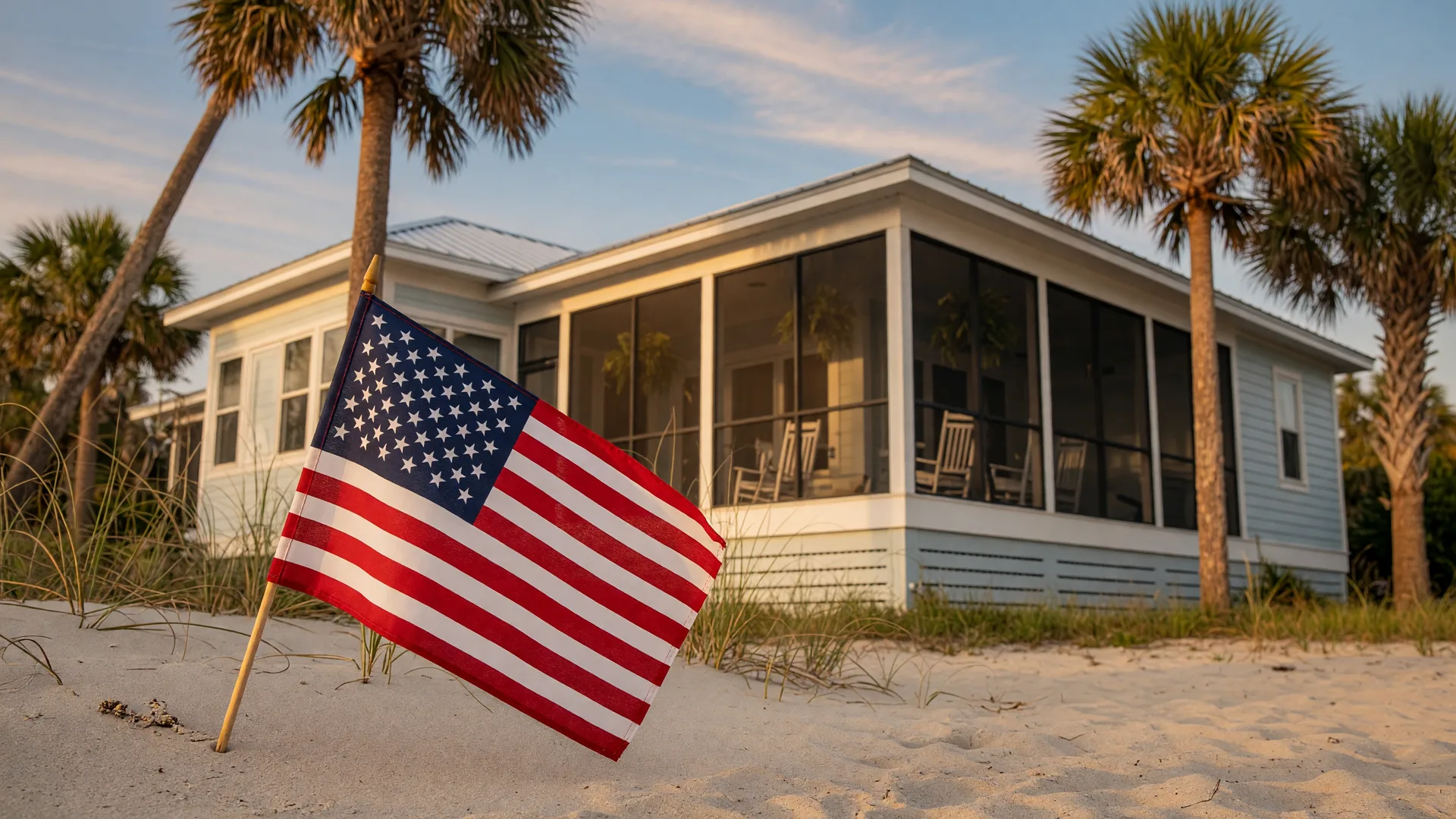
Yes, VA loans are available to Florida veterans, active-duty service members, National Guard and Reserve members, and many surviving spouses, and in 2026 they remain the most powerful mortgage benefit most buyers will ever qualify for. A VA loan lets you buy a home with zero down payment, no monthly mortgage insurance, and no VA-imposed loan limit when you have full entitlement. With Florida's roughly 1.5 million veterans and 30-year rates still averaging in the high 6s this fall, understanding how this benefit works can save you tens of thousands of dollars over the life of the loan.
Here is the honest version before you get excited. A VA loan is not a blank check. You still have to meet the lender's credit, income, and debt requirements, the home has to be your primary residence, and the VA funding fee applies unless you are exempt. The benefit is also a lifetime one, so the way you use it now affects how much entitlement you have left for the next home. But for the eligible borrower who qualifies, no other program combines zero down, no PMI, and competitive rates the way VA does.
In this guide I will walk you through who qualifies and how the Certificate of Eligibility works, the exact 2026 funding fee rates and exemptions, how entitlement and loan limits work, the Florida-specific costs you need to budget for, and the markets across the state where VA buyers are most active, from Jacksonville and Tampa to Orlando, Pensacola, and the Space Coast.
What Is a VA Loan and Why It's Different
A VA loan is a mortgage backed by the U.S. Department of Veterans Affairs. The VA does not lend you the money. It guarantees a portion of the loan to the private lender, which is what makes lenders willing to offer terms no other program matches. Because the government stands behind a share of the loan, lenders can offer 100% financing, meaning no down payment, and they do not require private mortgage insurance, because the VA guarantee replaces it.
The core features that make VA different from every other loan program:
- Zero down payment. Eligible borrowers can finance 100% of the purchase price, no 3% or 20% requirement.
- No monthly mortgage insurance. No PMI on a conventional loan, no MIP on an FHA loan. That alone is often $150 to $300 a month that stays in your pocket.
- Competitive interest rates. VA rates typically run at or below conventional rates because of the government guarantee.
- No prepayment penalty. You can pay the loan off early or refinance without a penalty.
- Assumable by another buyer. A future buyer can take over your VA loan at your rate, which can be a real selling point in today's market.
- A streamline refinance path. The VA IRRRL lets you refinance with limited income documentation when it makes sense.
The tradeoff is the funding fee, which I will break down below, and the occupancy requirement: VA loans are for homes you intend to live in as your primary residence, not vacation homes or rentals.
Who Qualifies: Service Requirements and the Certificate of Eligibility
Eligibility for a VA loan is not about credit or income, it is about service. The VA sets the service requirements, and you prove you meet them with a Certificate of Eligibility, or COE. Your lender can pull your COE electronically in most cases, often within minutes, but it helps to know where you stand before you start shopping.
- Active-duty service members: 90 continuous days of active service qualifies.
- Veterans: 90 days of wartime service or 181 days of peacetime service qualifies. Shorter periods can qualify if you were discharged for a service-connected disability or hardship.
- National Guard and Reserve members: Six qualifying years in the Selected Reserve, or 90 days of qualifying active-duty service, generally qualifies.
- Surviving spouses: Spouses of service members who died in the line of duty or from a service-connected disability may qualify, including those receiving Dependency and Indemnity Compensation.
Meeting VA eligibility is step one. Step two is lender underwriting, which is the same kind of review any mortgage gets: your credit score, your income and employment history, your debts, and your ability to cover the payment. There is no official VA minimum credit score, but most lenders want to see a FICO around 620 or better, and your debt-to-income ratio needs to fit the program. The good news is that because there is no down payment, your savings can go toward closing costs, reserves, and the funding fee instead of a 20% lump sum.
The VA Funding Fee in 2026: What You Pay and Who's Exempt
The VA funding fee is the one real cost that separates VA loans from a free lunch. It is a one-time fee the VA charges to help keep the program running, and it is set as a percentage of the loan amount. The rates below have been in effect since April 2023 and are unchanged for 2026.
- First-time use, less than 5% down: 2.15% of the loan amount.
- First-time use, 5% to 9.99% down: 1.5%.
- First-time use, 10% or more down: 1.25%.
- Subsequent use, less than 5% down: 3.3%.
- Subsequent use, 5% to 9.99% down: 1.5%.
- Subsequent use, 10% or more down: 1.25%.
On a $400,000 first-time purchase with no money down, the fee is 2.15%, or $8,600. You can pay it at closing, or you can finance it into the loan, which means it becomes part of your balance and your monthly payment. Most first-time VA buyers finance it, because the whole point of the program is to reduce the cash you need upfront.
The exemptions matter, and they are generous. You do not pay the funding fee if you receive VA disability compensation, or would receive it if you were not collecting military retirement pay. Active-duty Purple Heart recipients are exempt, as are surviving spouses receiving Dependency and Indemnity Compensation, and service members with a proposed or memorandum rating for a pre-discharge disability claim. If any of those apply to you, tell your lender early, because the exemption changes your closing costs significantly.
Zero Down and No PMI: What That Actually Saves You
Let me put real numbers on the two biggest VA advantages. Say you are buying a $400,000 home in the Tampa area. On a conventional loan with 5% down, you would need $20,000 in cash just for the down payment, plus closing costs, and you would carry private mortgage insurance because your equity is below 20%. PMI on a conventional loan typically runs about 0.3% to 1% of the loan amount per year, which on a $380,000 balance is roughly $100 to $300 a month, on top of your principal and interest.
With a VA loan, the down payment is zero, so that $20,000 stays in your savings account, and there is no PMI at all, because the VA guarantee stands in its place. At 30-year rates in the high 6s, that combination can be the difference between qualifying for the home and not, especially in coastal markets where prices are higher and every dollar of buying power counts.
The funding fee is the offsetting cost, and it is worth comparing honestly. On that same $400,000 loan, a 2.15% fee is $8,600, which is less than half of the $20,000 down payment you would have needed on a conventional loan, and unlike PMI it is a one-time cost rather than a monthly one. Financed over 30 years, it adds roughly $55 to $60 a month to the payment. Most borrowers find that a very good trade.
VA Entitlement and Loan Limits: Full vs. Partial
Entitlement is the amount of the loan the VA guarantees, and it determines how much you can borrow with zero down. This is where the "no limit" headlines get confusing, because the truth depends on whether you have full or partial entitlement.
If you have never used your VA benefit, or you have fully restored your entitlement, you have full entitlement, and there is no VA-imposed loan limit. The VA guarantees 25% of whatever loan amount the lender approves, with no cap tied to county limits. That means a veteran with full entitlement can finance a $700,000 or $900,000 home with zero down, subject only to the lender's underwriting and, in high-value markets, jumbo pricing.
If you have partial entitlement, because you used part of your benefit on a prior VA loan that is still active, county loan limits apply. The 2026 baseline conforming limit is $832,750 in most Florida counties, with higher limits in high-cost counties. With partial entitlement, you can borrow up to the county limit with no down payment, but the portion above the limit generally requires a down payment. The fix is straightforward: when you sell a home bought with a VA loan and pay the loan off, your entitlement is restored, which is why the benefit is described as a lifetime one that can be used repeatedly.
VA Loans in Florida: Insurance, Taxes, and Flood Zones
A VA loan gets you into the home with zero down, but your monthly payment in Florida is built from more than principal and interest. Property taxes and homeowners insurance are escrowed into the payment, and in much of the state flood insurance joins them. These are the costs that surprise out-of-state veterans the most, so budget for them before you commit to a payment.
Homeowners insurance in Florida has been the single biggest swing factor in monthly payments over the past few years. Premiums have moderated in 2026 after several rough years, but coverage still costs meaningfully more than the national average, and lenders require it on every VA loan. Your loan officer can help you get a realistic insurance quote for the property before you make an offer, and you should treat that number as part of your budget, not an afterthought.
Flood insurance is required when the home sits in a Special Flood Hazard Area, and in coastal Florida that is common. A flood zone designation can add hundreds of dollars a month to your total housing cost, so check the flood map for the property early. If you are looking at a condo, confirm the building's flood policy and what it covers, because the association's coverage interacts with your own.
Property taxes are the other big line item, and Florida buyers should understand the homestead exemption, which caps the assessed value growth on a primary residence and can lower your tax bill once you own the home. Your mortgage escrow will start from the current owner's tax bill, so expect an adjustment after the property is reassessed under your ownership. A good lender walks you through this before closing, not after.
Florida's Strongest Markets for VA Buyers
Florida has roughly 1.5 million veterans, the third-largest veteran population in the country, and VA lending is concentrated in the metros with the biggest military communities. Knowing where the benefit is most common helps you understand both competition and opportunity.
- Tampa, St. Petersburg, and Clearwater: The largest veteran population of any Florida metro at roughly 220,000 veterans. MacDill Air Force Base anchors the market, and VA loans are a normal part of the buying conversation here.
- Jacksonville: Home to roughly 141,000 veterans and one of the highest veteran concentrations per capita in the nation, with Naval Air Station Jacksonville and Mayport nearby. VA loans make up close to one in five mortgage originations in the market, so sellers and agents are used to them.
- Orlando: A fast-growing market with a large veteran and active-duty community around the region's military installations, and VA financing is widely accepted on new construction and resale homes alike.
- Pensacola and the Panhandle: Naval Air Station Pensacola and Eglin Air Force Base make this one of the most VA-friendly corridors in the state, with strong inventory at a range of price points.
- Palm Bay and Melbourne (Brevard County): Patrick Space Force Base and the Space Coast give this area one of the highest concentrations of VA loan transactions in Florida, with a mix of single-family homes and condos.
- Miami-Dade, Broward, and Palm Beach: South Florida's veteran community is smaller relative to the population, but VA buyers are active here too, often in condos and townhomes. Just confirm the condo is on the VA's approved list, because not every association qualifies.
Wherever you buy, sellers in veteran-heavy markets understand VA loans, which removes most of the old stigmas about "VA buyers." The offer itself still needs to be competitive, and a pre-approval letter from a lender who regularly closes VA loans makes your offer stronger.
How to Use Your VA Benefit More Than Once
The VA loan benefit is a lifetime benefit, and there are three main ways veterans use it again after the first purchase.
First, when you sell a home bought with a VA loan and pay the loan off, your entitlement is restored, and you can use the benefit again on your next primary residence. Second, if you keep the first home as a rental, you can apply to have your entitlement restored while the loan stays in place, as long as the new purchase will be your primary residence and you meet the occupancy rules. Third, the VA IRRRL, or Interest Rate Reduction Refinance Loan, lets you refinance an existing VA loan into a new VA loan with streamlined documentation, no appraisal in many cases, and the funding fee reduced to 0.5% of the loan amount.
There is also the assumption route worth knowing about. VA loans are assumable by any qualified buyer, including civilians, which matters if you ever sell: a buyer can take over your loan at your rate, and if you are selling in a high-rate market, that is a genuine advantage. On the buying side, a veteran can also assume another seller's VA loan, and the funding fee on an assumption is just 0.5% of the remaining balance. It is one of the smartest moves available in today's rate environment if the numbers line up.
Frequently Asked Questions
Do I qualify for a VA loan in Florida?
You qualify if you meet the VA's service requirements: 90 continuous days of active duty, 90 days of wartime service or 181 days of peacetime service as a veteran, six qualifying years in the Selected Reserve, or eligible surviving-spouse status. You also need a Certificate of Eligibility and must pass your lender's credit, income, and debt review. The home must be your primary residence.
How much is the VA funding fee in 2026?
For first-time use, the fee is 2.15% of the loan amount with less than 5% down, 1.5% with 5% to 9.99% down, and 1.25% with 10% or more down. For subsequent use, it is 3.3% with less than 5% down and 1.5% with 5% or more down. The fee can be financed into the loan, and it is waived for veterans receiving VA disability compensation, Purple Heart recipients, and eligible surviving spouses.
Can I use a VA loan to buy a condo in Florida?
Yes, but the condo association must be on the VA's approved list, which requires the project to meet VA's review standards for finances, insurance, and owner-occupancy. Not every Florida association qualifies, so check approval status before you fall in love with a unit. Your lender can verify whether a specific building is approved.
Can I use my VA loan more than once?
Yes. The VA loan is a lifetime benefit. When you sell a VA-financed home and pay off the loan, your entitlement is restored and you can use the benefit again. You can also apply to restore entitlement while keeping the first home as a rental, and the VA IRRRL lets you refinance an existing VA loan with streamlined documentation.
Do VA loans require mortgage insurance?
No. VA loans do not require private mortgage insurance or any monthly mortgage insurance premium, because the VA's guarantee to the lender replaces it. That is one of the program's biggest advantages, and it typically saves VA borrowers $150 to $300 a month compared with a low-down-payment conventional loan.
Can a civilian assume a VA loan in Florida?
Yes. VA loans are assumable by any qualified buyer, including civilians who never served, as long as the lender or VA approves the assumption and you pass the credit and underwriting review. The funding fee on an assumption is 0.5% of the remaining balance. One catch: when a non-veteran assumes the loan, the seller's VA entitlement generally stays tied to the loan until it is paid off.
Final Thoughts
If you have earned the VA loan benefit, it is almost always the first program to look at for a Florida primary residence. Zero down, no PMI, competitive rates, and a lifetime benefit you can reuse are a combination no other loan program matches. The real work is in the details: getting your COE in order, understanding whether you have full or partial entitlement, budgeting the funding fee unless you are exempt, and pricing the Florida costs that actually drive your payment, insurance, taxes, and flood coverage.
My advice is to talk to a lender who closes VA loans regularly before you start touring homes. A VA specialist will tell you exactly what your entitlement situation looks like, what payment you can realistically support, and whether the condo or new-construction community you like is VA-approved. That clarity turns the strongest benefit in mortgage lending into a smooth, confident purchase, and it is exactly the kind of conversation I enjoy having with every veteran who reaches out.
My job isn't to sell you a mortgage. It's to help you understand your options, avoid costly mistakes, and choose the financing strategy that truly fits your goals.
Austin Edwards, Mortgage Loan Originator

Austin Edwards
Mortgage Loan Originator · NMLS #2639747
Austin helps Florida homebuyers understand their options and make confident mortgage decisions. He believes an educated buyer makes better financial choices.
More Resources
Want to see how VA stacks up against other programs? Read the FHA vs. conventional vs. VA comparison, learn how VA assumptions can save you thousands, and check the latest Florida rate environment update. You can also reach out to Austin directly with your questions.
Have a question? Ask Austin.
Not sure if you qualify, or whether your entitlement is full or partial? Austin would be glad to pull your COE with you and map out your options. No commitment, no sales pitch. Just a straight answer.
Ask Austin a QuestionReady to put your VA benefit to work in Florida?
Austin will help you confirm eligibility, review your entitlement, and get you pre-approved so you can shop with confidence. No pressure. Just honest guidance from a lender who closes VA loans regularly.